

Marіana Aleksandrenko’s Story
Learning to Walk This Path for Others
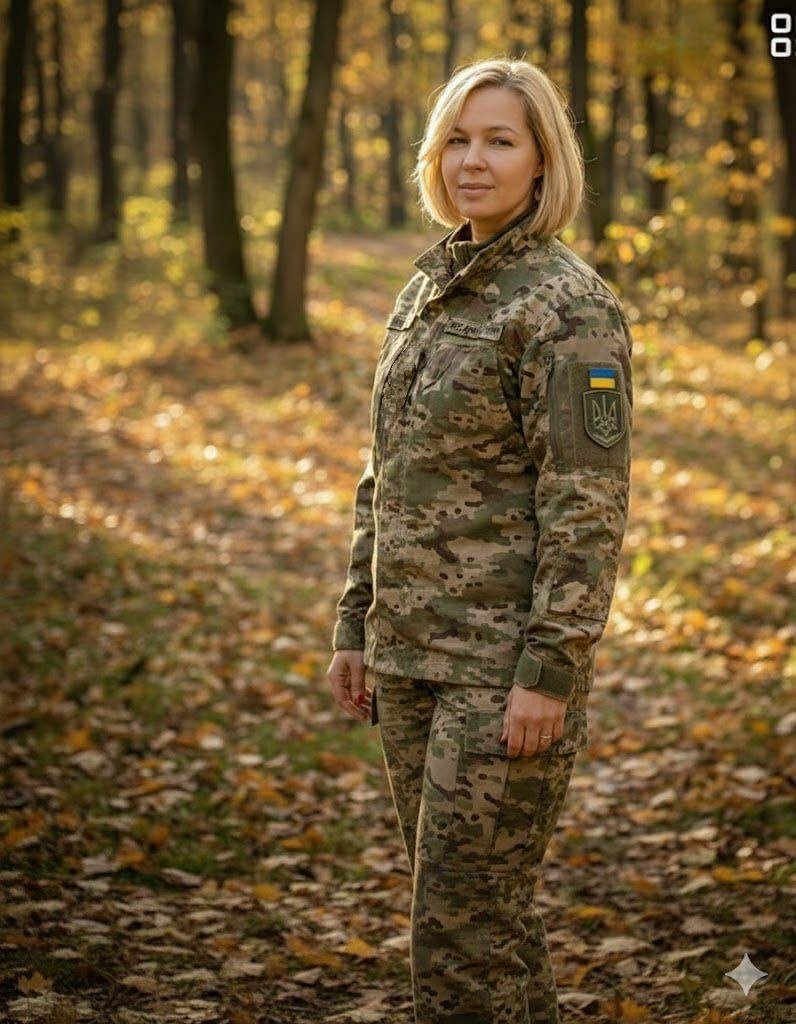
Mariana is a psychologist and a paramedic with the Hospitallers Battalion. Today she is also a participant in the training program in Group Ketamine-Assisted Psychotherapy (G-KAP). When she first entered the program, she came not as a future practitioner but as someone carrying her own experience of loss, exhaustion, and the quietly accumulated weight of events. Now she is studying so that she can help others walk a similar path.
The morning she received the news began with the insistent ringing of her phone. Her daughter was calling, and, even before answering, Mariana sensed that something irreversible had happened. There are moments when the body understands before the mind does, and when she reached for the phone that understanding was already there.
In their unit’s internal chat, of their unit a short message had appeared, written in the brief language of military reporting. The driver of her crew, a man with whom she had worked side by side for three years, had been killed. That day he had gone out on a call alone while she remained behind, too exhausted to move after a difficult evacuation the night before.
“It felt as though I had slept through his death,” Mariana recalls.
After that moment, Mariana’s life no longer unfolded as a continuous movement forward. Instead, it seemed to gather itself into a series of pauses, as though time had begun circling around a single event that could neither be reversed nor easily absorbed into the ordinary rhythm of days.
Alongside a sense of guilt she could neither explain nor release, something else began to change. Her body, which had carried her through countless evacuations and long nights of work, seemed to withdraw its quiet cooperation. Movements that once felt effortless became difficult; her legs would not straighten, her back remained held in a tension she could not soften, and the ease that had once accompanied ordinary physical movement seemed suddenly distant. The pain itself had no single point of origin, yet it seemed to inhabit her whole body, as if the event had left behind a presence that could not easily be named.
As a psychologist, Mariana understood the language of trauma well. She knew how the mind builds protective structures that allow a person to continue functioning even after devastating loss. Yet knowledge does not always ease passage through the experience itself, and she found herself in the unusual position of recognizing these mechanisms while still feeling unable to move beyond them.
It was at this moment that her attention returned to an approach she had previously encountered only as a professional interest.
In the field ketamine was a practical tool of emergency medicine, a medication capable of easing pain and buying the precious minutes needed to save a life. The idea of encountering it within psychotherapy required personal as well as clinical trust.
Turning toward ketamine-assisted psychotherapy (KAP) became a deliberate step, taken when it became clear to Mariana that familiar ways of coping no longer sufficed.
Vyacheslav Zaika, the physician with whom Mariana worked at the Lisova Polyana Mental Health Center, played an important role in this process. Hisprofessional presence and steadiness helped create an environment in which she could allow herself to enter the experience without the fear of losing control.
The early sessions were not easy, yet they revealed something unexpectedly new. For the first time in a long while, Mariana sensed that her body could inhabit a state not defined by constant vigilance.
“I realized that the medicine was holding me, and that my body could begin to see that it was safe,” she says.
This realization did not erase pain overnight. KAP offered the beginning of a process in which the body slowly rediscovered its capacity for trust. Movement returned cautiously at first, as though she were testing the edges of what was possible, and then with growing confidence as the connection between body and mind gradually re-established itself.
Individual therapy opened the door to this process, yet over time Mariana began to sense that healing that could not fully emerge within the boundaries of one-on-one work. It was this intuition that led her to join the group KAP program.
What unfolded in the group was not limited to the inner work of each participant but extended into the space between them. In a room where every person arrived with their own history of loss and endurance, a shared atmosphere formed, one that required little explanation because each participant could recognize something of their own story in the presence of others.
For Mariana, this realization proved as meaningful as the therapy itself, because it suggested that even the deepest forms of pain can be held when others remain present beside them.
Today, she continues this journey in a new role. Mariana is now training in the program for facilitators of group KAP, a step that feels like a natural continuation of her own experience. She hopes to work with soldiers, paramedics, and veterans—people who, as she once did, may find themselves at a point where familiar ways of coping no longer work.
For Mariana, this method is not an abstract concept but part of her own story. KAP allowed her to move through a state that once felt closed and immovable and gradually rediscover the simple yet profound capacity to feel, to move, and to be present in her own life.